

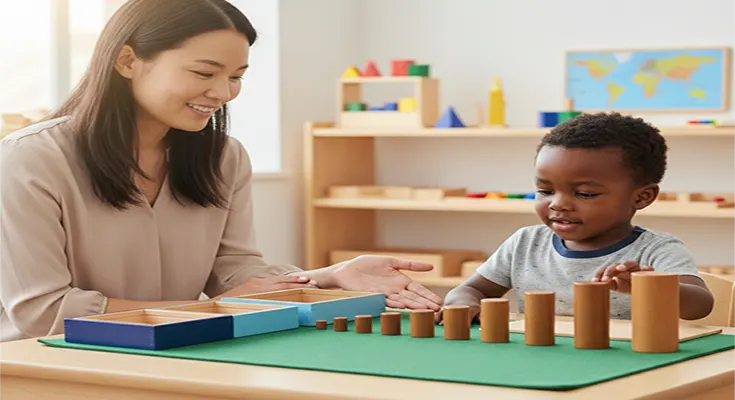
When it comes to Montessori materials, some stand out for their simplicity and the depth of learning they offer.
The Montessori knobless cylinders are one of those treasures. At first glance, they may look like just colorful wooden cylinders in varying sizes.
But in reality, they provide a wealth of opportunities for a child’s development — building visual discrimination, concentration, problem-solving, and early math skills.
If you’re curious about how to introduce knobless cylinders in a meaningful way, you’re in the right place.
Let’s walk through their purpose, the best way to present them, and how to make the experience engaging for your child at home or in the classroom.
What Are Montessori Knobless Cylinders?
The knobless cylinders are a set of four color-coded boxes:
- Red cylinders – vary in diameter but remain the same height.
- Yellow cylinders – vary in height but keep the same diameter.
- Blue cylinders – vary in both height and diameter.
- Green cylinders – vary inversely (as one dimension increases, the other decreases).
Together, they encourage children to compare, contrast, and notice relationships between size, dimension, and order.
Unlike the knobbed cylinders, which rely on fitting pieces into sockets, the knobless versions invite open-ended exploration and visual problem-solving.
Why They Matter
The beauty of knobless cylinders is that they’re not just about stacking blocks. They are carefully designed to support:
- Visual perception: Children refine their ability to see differences in size and dimension.
- Fine motor skills: Handling small cylinders builds control and precision.
- Concentration: Ordering and sequencing activities demand focus.
- Foundations for math: Early exposure to dimension lays groundwork for geometry, algebra, and measurement.
At Dannico Woodworks, we’ve seen firsthand how thoughtfully designed Montessori-inspired materials (and the furniture to support them) can transform how children learn and explore.
By giving kids tools that are safe, functional, and engaging, you’re fostering independence and curiosity from the start.
When To Introduce Knobless Cylinders
Knobless cylinders are typically introduced around 3.5 to 4 years old, though every child is different. If your child is already showing an interest in puzzles, stacking, or ordering objects, they may be ready.
Signs they might be ready include:
- Curiosity about size differences (e.g., saying “bigger” or “smaller”).
- Enjoyment of stacking and ordering toys.
- Ability to focus for short periods on simple tasks.
How To Introduce the Knobless Cylinders Step by Step
Here’s a gentle, practical approach:
1. Prepare the Environment
Children thrive in calm, uncluttered spaces. Present the cylinders on a clean mat or low table so your child can see all the pieces clearly.
2. Start With One Box
Begin with the red or yellow set. These are more straightforward since only one dimension changes at a time. Introduce just one box at first to avoid overwhelming your child.
3. Demonstrate Slowly
Without rushing, take the cylinders out and place them randomly on the mat. Then, show how to build a tower or arrange them from smallest to largest. Use minimal words — children learn best by observing.
4. Invite Exploration
Once you’ve shown the process, let your child take over. They might not get it “right” at first, but that’s perfectly fine. The goal isn’t perfection, it’s exploration.
5. Add Variety Over Time
After your child becomes confident with one box, introduce another. Later, they can mix sets to compare relationships between different dimensions.
6. Step Back
The magic happens when you resist the urge to correct. Allow them to experiment, even if it means stacking them in “wrong” order. Each attempt builds their independence and problem-solving.
Extension Activities
Once your child is familiar with the cylinders, you can add playful challenges to keep learning fresh:
- Mix two sets and see if they can order them together.
- Pattern building – lay out alternating sequences (tall-short-tall-short).
- Matching across sets – find cylinders of the same height but different diameter.
- Silent game – challenge them to build a tower quietly, encouraging control and focus.
These variations gently increase the complexity while keeping the activity fun.
Common Mistakes To Avoid
- Introducing all four sets at once – it can overwhelm younger children.
- Correcting too much – the Montessori approach values independence. Trust your child’s process.
- Rushing the progression – stay with one set until your child is fully engaged and ready to move on.
FAQs
What age is best for knobless cylinders?
Most children are ready around 3.5 to 4 years old, though some may be interested earlier or later.
How are knobless cylinders different from knobbed cylinders?
Knobbed cylinders are more self-correcting since each cylinder fits into a socket. Knobless cylinders, on the other hand, demand more visual discrimination and are more open-ended.
Do I need all four sets?
Ideally, yes. Each set offers a unique challenge, and together they provide the full range of dimensional exploration. However, starting with one or two is perfectly fine.
Can I use them at home without formal Montessori training?
Absolutely. The key is to present them slowly, allow exploration, and avoid over-directing. The design itself guides the child’s learning.
How do knobless cylinders support math readiness?
By comparing dimensions, children develop the ability to see relationships — skills that later support geometry, algebra, and measurement concepts.
Final Thoughts
The Montessori knobless cylinders are a timeless tool for helping children refine their senses, practice concentration, and build early math skills.
They remind us that learning doesn’t have to be complicated — sometimes the simplest materials provide the richest experiences.
At Dannico Woodworks, we believe in creating environments that support this kind of discovery. Just as Montessori materials are crafted to empower independence, our furniture is designed with the same goal: safe, functional, and inspiring spaces where kids can learn and grow.
Are you ready to see how your child will explore, discover, and create with tools like the knobless cylinders?